Is Your HR Software Actually PIPEDA Compliant? A Checklist
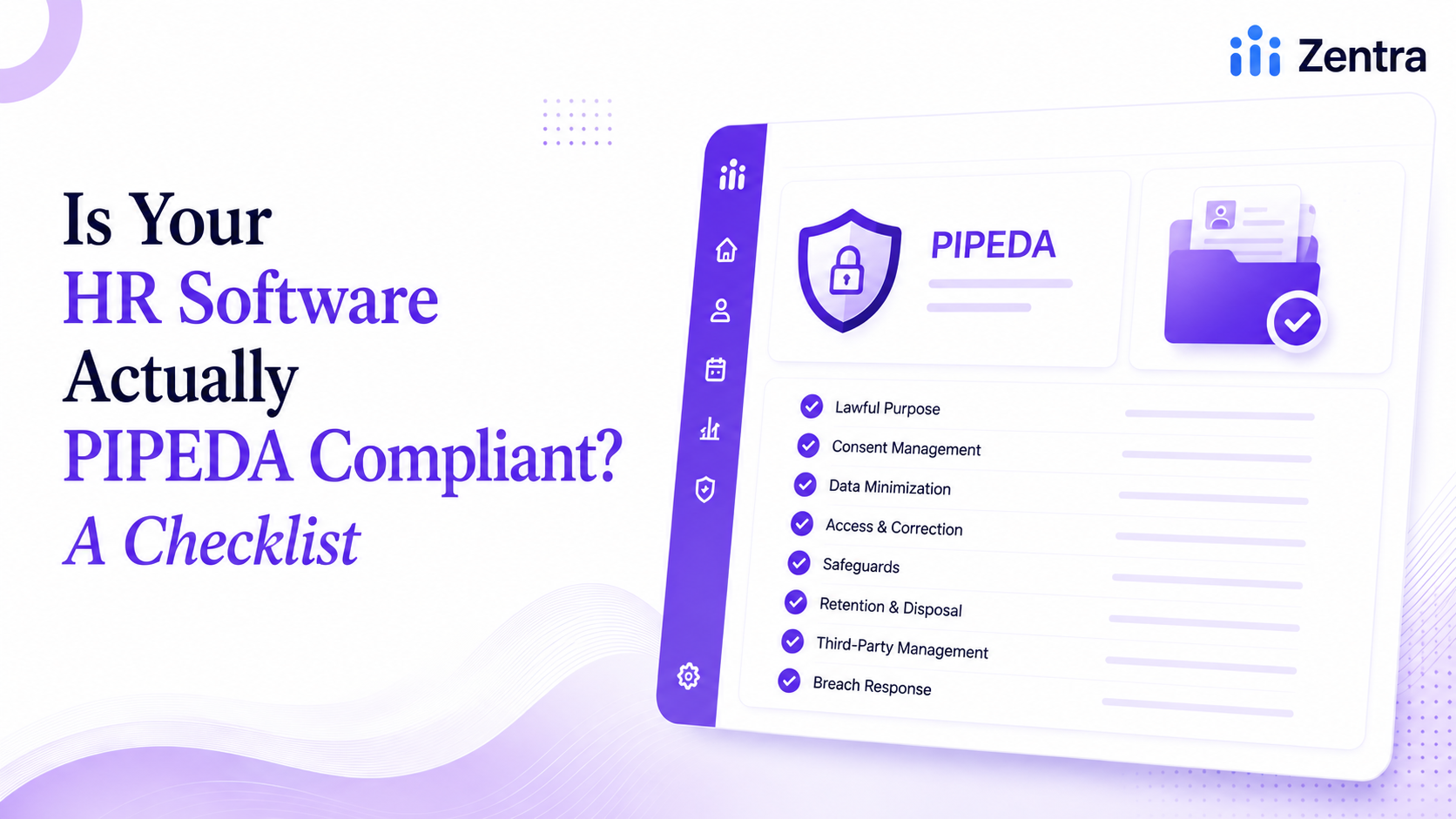
"PIPEDA compliant" shows up on a lot of HR software pricing pages, usually as a single line sitting next to a padlock icon. It's rarely explained further, and it's almost never something a buyer is invited to verify. That's a problem specifically for HR software, because employee records - salaries, government ID numbers, sometimes health information tied to leave - are exactly the kind of personal information PIPEDA exists to protect.
Here's what "PIPEDA compliant" should actually mean when an HR vendor says it, and the specific things worth checking before taking the claim at face value.
Ask which principles it actually addresses, not just whether it's "compliant"
PIPEDA is built around specific fair information principles: accountability, consent, limiting collection, accuracy, safeguards, openness, and individual access, among others. A vendor that can walk through how their platform handles even three or four of these specifically is telling you something real. A vendor whose entire answer is "yes, we're PIPEDA compliant" with nothing underneath it is telling you they've read the same one-line badge every competitor uses.
Check whether employees can actually see and correct their own data
PIPEDA's openness and individual-access principles mean people have a right to know what's held about them and to correct it if it's wrong. In HR software terms, this should show up as something concrete: can an employee log in and see their own record, or does correcting a typo in someone's address require an email to HR and a database edit on the vendor's end? The second answer isn't necessarily non-compliant, but it's a meaningfully weaker implementation of the same principle.
Ask what happens during a data breach, specifically
Since 2018, PIPEDA has required organizations to report breaches involving a real risk of significant harm to the Privacy Commissioner and to affected individuals, and to keep records of every breach regardless of severity. A vendor with a real answer here can tell you their notification timeline and process without hesitating. A vendor without one usually hasn't thought about it past the marketing page.
Check whether the vendor accounts for provincial law, not just PIPEDA
This is the check most buyers skip, and it matters more than it looks. Alberta, British Columbia, and Quebec each have their own private-sector privacy legislation that applies instead of PIPEDA within that province. Quebec's Law 25 in particular introduces requirements stricter than PIPEDA's federal baseline. A vendor whose compliance page mentions only PIPEDA and nothing provincial is describing part of the Canadian legal picture, not the whole thing.
Watch for outdated legislative references - this is a real, current gotcha
Canada's privacy law landscape moved in 2026: Bill C-27, which would have introduced the Consumer Privacy Protection Act (CPPA), died when Parliament was prorogued in early 2025. It's since been replaced by Bill C-36, introduced in June 2026, which proposes a new law called the Protecting Privacy and Consumer Data Act with a substantially higher penalty ceiling. If a vendor's compliance page still references "CPPA" or "Bill C-27" as upcoming law, that's not a minor wording issue - it's citing legislation that no longer exists in that form, and it's a fair signal that the compliance page hasn't been reviewed recently.
Ask about encryption and access control in specific terms
"Bank-level encryption" is a marketing language. "AES-256 encryption at rest, with role-based access control limiting who can view payroll data" is a specific, checkable claim. PIPEDA's safeguards principle doesn't mandate one specific encryption standard, but a vendor that can't describe their approach in specific technical terms usually hasn't implemented one that's easy to describe.
Ask what happens to your data if you switch platforms later
Not a PIPEDA requirement directly, but a fair proxy for how seriously a vendor takes the rest of this list. A vendor confident in its own compliance posture generally has no reason to make leaving difficult. One that's vague about exports or historical data access is worth a second look.
Where Zentra fits
Zentra is built around PIPEDA's principles directly, alongside the provincial laws that apply instead of the federal baseline in Alberta, BC, and Quebec, and India's DPDPA for organizations connected there too. Data is encrypted at rest with AES-256-GCM, access is governed by role-based permissions, and every action is logged in an audit trail that can't be altered after the fact - specifics, not a badge.
FAQ
What does PIPEDA actually require of HR software?
PIPEDA requires organizations handling personal information, employee data included, to follow principles like accountability, meaningful consent, limiting collection to what's needed, keeping data secure, and letting individuals access and correct their own information.
Is PIPEDA the only privacy law that applies to Canadian HR data?
No. Alberta, British Columbia, and Quebec each have their own private-sector privacy legislation that applies instead of PIPEDA within that province, and Quebec's Law 25 introduces stricter requirements than the federal baseline.
What's the difference between PIPEDA and the CPPA?
The CPPA was proposed under Bill C-27, which died in January 2025. It's since been replaced by Bill C-36, introduced in June 2026, proposing a new law called the Protecting Privacy and Consumer Data Act. Neither has taken effect yet - PIPEDA remains the law currently in force.
Does PIPEDA require a specific encryption standard?
No, PIPEDA's safeguards principle requires appropriate security measures without mandating one specific method. Vendors that describe their encryption and access controls in specific technical terms are generally more trustworthy than those using only general marketing language.